
New member added to the topological magnetic structure family: "magnetic vortices" with multiple topological charges discovered in the strong magnetic field center
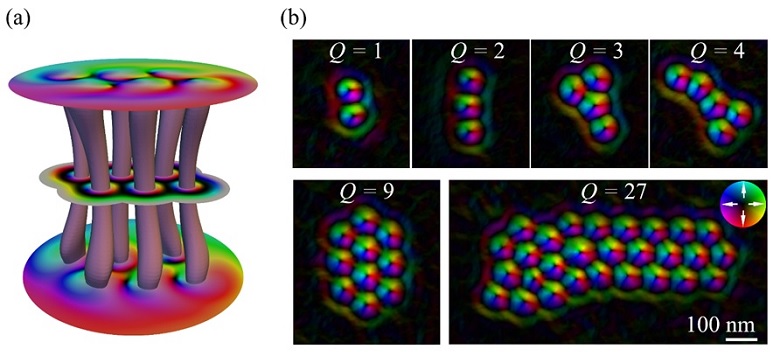
Data storage is a crucial cornerstone in the development of the information society. Magnetic storage devices, represented by hard disks, store approximately 70% of the world's data, but their storage speed, density, and energy consumption are all approaching their functional limits. Therefore, the search for novel magnetic materials and magnetic structures to construct high-speed, high-density, and low-energy-consumption magnetic storage devices is a significant demand in the development of the national information field. In 2009, scientists discovered a nanoscale magnetic structure called magnetic skyrmion in chiral magnetic materials. Compared to traditional magnetic domains, the magnetic moment of a magnetic skyrmion is arranged in a vortex-like pattern, which can generate a unit magnetic topological charge and a layered electromagnetic field, leading to strong spin-electron interactions between electrons and magnetic skyrmions. On the one hand, when electrons pass through a skyrmion, the layered electromagnetic field exerts an influence on the electrons, causing a change in their direction of motion and generating the topological Hall effect. On the other hand, electrons can effectively propel the motion of the skyrmion through spin torque interaction. Subsequently, various topological magnetic structures such as magnetic skyrmions, magnetic bubble skyrmions, magnetic skyrmions, and magnetic hopfons have been discovered in magnetic materials. These magnetic structures exhibit similar characteristics to skyrmions, possessing strong spin-electron coupling properties and demonstrating great potential as novel data carriers for constructing a new generation of high-performance spintronic devices. In-depth research on these topological magnetic structures has gradually formed an important research branch of spintronics—topological magnetoelectronics. The core scientific issue in the study of topological magnetoelectronics is the generation and manipulation of topological magnetic structures. However, the topological charges of traditional topological magnetic structures are mostly unit topological charges (0 or ±1). Although theories of multi-topological magnetic structures such as "Skyrmion bag" and "multi-topological state magnetic vortex" have been proposed, they have never been experimentally confirmed. The research team of magnetic functional materials and devices at the High Magnetic Field Center of the Hefei Institute of Physics, Chinese Academy of Sciences, in collaboration with Anhui University and the University of New Hampshire, first proposed a three-dimensional multi-topological magnetic structure consisting of an intermediate layer of "Skyrmion bag" combined with a surface layer of "multi-topological state magnetic vortex" through three-dimensional micromagnetic simulation. Considering its configuration resembling a superconducting-superconducting vortex bundle, this magnetic structure was named "Skyrmion Bundles", abbreviated as "Magnetic Bundles" (Figure 1(a)). Subsequently, the research team utilized focused ion beam micro-nano fabrication technology to fabricate nanostrip devices. By reversing the magnetic field of the mixed state of skyrmions and helical magnetic domains in zero magnetic field, they successfully realized the novel "Magnetic Bundles" topological magnetic structure in experiments. Using Lorentz transmission electron microscopy for in-situ magnetic structure observation and control, the research team observed "Magnetic Bundles" with different magnetic topological charges for the first time in this magnetic structure (Figure 1(b)), and based on this, they studied the motion behavior of "Magnetic Bundles" driven by nanosecond pulse current. The results showed that multi-topological "Magnetic Bundles" exhibit particle behavior, capable of moving as a whole under current driving, and their motion trajectory is closely related to the sign of topological charge. The experimental discovery of "magnetic skyrmions" with multiple topological charges expands the research scope of topological magnetoelectronics from unit topological charges to multiple topological charges, revealing the diversity of topological magnetic structures in magnetic materials. This provides a new data carrier for the future development of multi-state storage, logic, and information processing devices, and is expected to open up new research areas in topological magnetoelectronics (Figure 2). Jin Tang, an associate researcher at the High Magnetic Field Science Center, is the first author of this paper, while Haifeng Du, a researcher, serves as the corresponding author. This research has been supported by the National Natural Science Foundation of China, the National Key R&D Program, the Scientific Research Instrument and Equipment Development Project of the Chinese Academy of Sciences, the Frontier Key Projects, the Youth Innovation Promotion Association, and the High Magnetic Field Laboratory in Anhui Province.