
Blue Brain Project
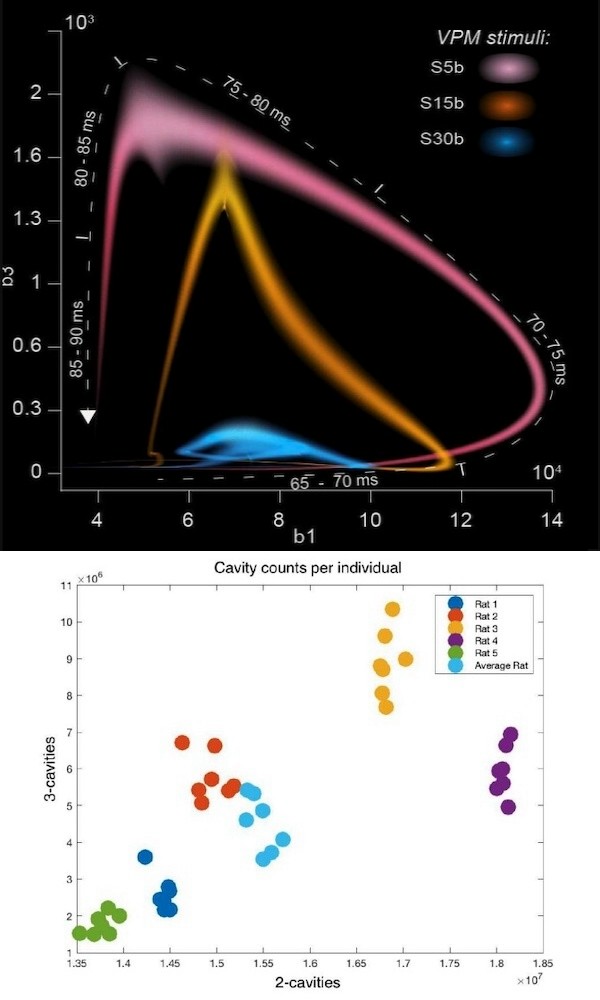
Prof Hess uses dimension reduction to represent the tangle of neurons in the brain by a graph or network. Each neuron, despite its shape or size, is represented by a node. And a single edge is used to represent any number of synapse connections between two neurons, even though there can be many synapse connections between them (this redundancy in connections is thought to be important in brain function). Because information passes in a definite direction along a synapse (from the axon of one neuron to the dendrites of another) these edges are directed – the arrows show the direction in which information can pass from one neuron to another. And it is possible to have reciprocal edges, where two neurons are connected to each other by two edges each pointing in opposite directions. This directed network provides a simplified structure of brain function.