
Phosphorescent metallaknots of Au(I)-bis(acetylide) strands directed by Cu(I) π-coordination
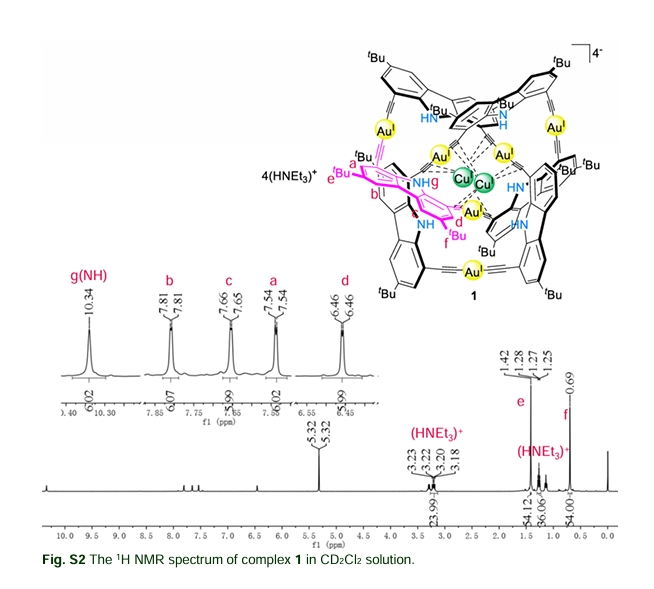
The kink structure widely exists in various tools, materials and buildings. Molecular junctions are ubiquitous in DNA, RNA, protein, polymers and liquid crystal structures. Broadly speaking, the closed-loop structure formed by inserting, winding and knotting a chain molecule is called a molecular knot. Generally speaking, molecular knot is a closed-loop structure formed by interpenetrating and winding molecular chains. Molecular junctions containing metal atoms are called metal junctions. Although some metal junctions have been synthesized by one-pot self-assembly, it remains to be studied to design, synthesize and prepare metal junctions by controlling the winding and closed-loop connection of molecular chains. Fujian institute of research on the structure researcher Chen Zhongning's research group cooperated with Sean, a professor at East China Normal University, and put forward the strategy of "coordination closed loop". This strategy can transform a entangled metal complex into a metal junction, which provides a general method for designing and synthesizing metal junction topology. The self-assembly of carbazole -1,8- diyne with Au+/Ag+ or Au+/Cu+ was studied, and a series of compounds with [2]- hydrocarbon, trefoil knot and "8" were prepared. The winding structure of Au6Cu4 and Au6Cu2 and Au8Cu6 trefoil knot were obtained by adjusting the reactant ratio. These special topological structures are the result of Cu+ ion template effect and metal-metal interaction. Cu+ ion induces the folding and interpenetration of Au- alkyne chain by coordinating with ethynyl π-; Furthermore, metal ions further stabilize these distorted configurations by forming rich Au-Cu or Au-Au interactions. If the uncoordinated -C≡CH group on the side of Au6Cu4 winding structure is combined with the linear [auph < sub > 2 (ch < sub > 2 ) < sub > 4 pH < sub >. The research shows that changing the proportion of building blocks leads to the formation of two trefoil knot with different stoichiometry and symmetry (C2 or D3) and a winding structure. Although the winding structure is formed by accident, the chain ends can be connected by the strategy of "coordination closed loop", and the 41 metal junction, that is, the "8" junction, can be accurately prepared. The phosphorescence of these molecular junctions can be attributed to their kink conformation, which gives them excellent rigidity. This rigidity minimizes the non-radiative thermal inactivation process in the triplet state, making them have excellent phosphorescence properties. This strategy based on Au(I)- bis (ethynyl) connection, π-bonded Cu(I) template and coordination closed loop provides a new method for obtaining various strong phosphorescent nano-topologies. Recently, related research results were published in the Proceedings of the National Academy of Sciences. The research work is supported by the National Natural Science Foundation, Fujian Science and Technology Plan Project and Shanghai Natural Science Foundation.