
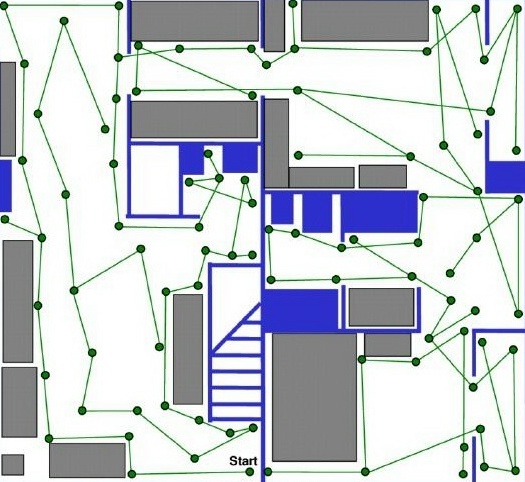
Topological Map and Navigation
As another mainstream navigation method based on structured memory, topological navigation is based on the principle of topology, which uses the connection relationship between nodes and edges to describe the environment and construct a topological map. Topological map is an abstract map representation method, which does not need to record accurate physical coordinates and dimensions, but only records nodes and topological relationships between nodes. In a topological map, nodes represent key locations in the environment, that is, landmarks, such as rooms, doors, corridors, etc., while edges represent the adjacency between nodes, such as doors connecting two rooms, corridors connecting two nodes, etc. In robot navigation based on topological map, the robot obtains environmental information through specific sensors, and matches this information with topological map to determine its position. After positioning is completed, the shortest path to the target position is calculated by using the nodes and edges on the topological map, and it moves along the path according to a specific control algorithm.