
Topological Kerr effects in two-dimensional magnets with broken inversion symmetry
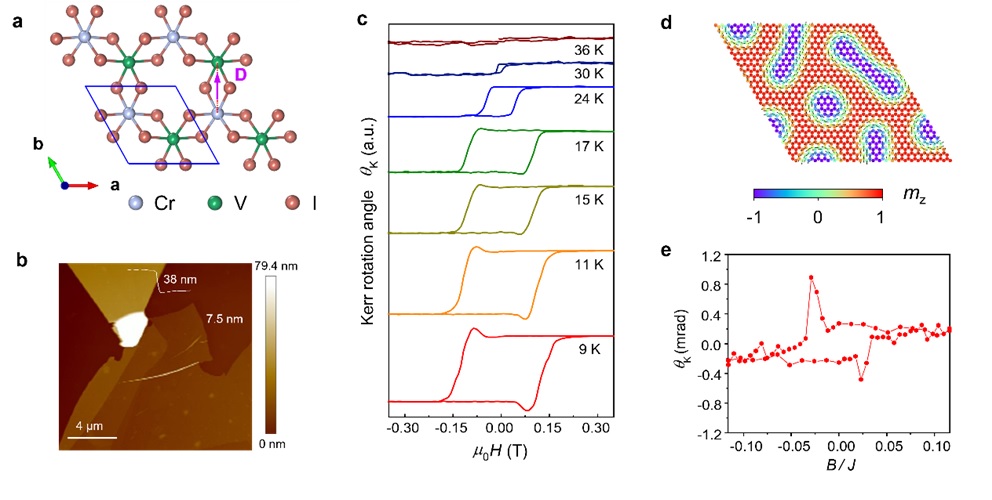
Hefei Institute of Material Science, China Academy of Sciences cooperated with China University of Science and Technology, and made progress in theoretical and experimental research on the excitation of two-dimensional new quantum magnet's Schmitt, and put forward the concept of "topological Kerr effect". The concept of Sigmon originated from particle physics, and it is widely used to describe a unique kind of topological element excitation in condensed magnetic materials. Its spins are arranged in a spiral or ring shape in real space, and the whole has non-mediocre topological characteristics, which can become the information carrier of a new generation of magnetic storage and logic devices. The topological Hall effect in electrical measurement is often used as one of the powerful criteria for the characterization of Sigmons, but electrical measurement is only applicable to metal systems. With the effective expansion of topological magnetic materials, it is urgent to develop characterization methods suitable for more systems, such as the characterization of non-metallic systems. In 2017, scientists discovered two-dimensional ferromagnetic materials CrI3 and CrGeTe3 in experiments. On this basis, the research team predicted a new type of two-dimensional ferromagnetic material CrI3 6 (m = Mn, v; X=I, Br)。 This time, the research team synthesized high-quality two-dimensional CrVI6 single crystal by chemical vapor transport method, and carried out high-precision micro-area magneto-optical Kerr effect research based on SHMFF's low-temperature magnetic field micro-optical system, confirming that thin-layer CrVI6 material also has ferromagnetic ground state. It is found that in a specific thickness range and temperature range, there are two anti-symmetric cat-ear "bumps" in the magnetization reversal region of magneto-optical Kerr loop. This characteristic is completely different from the M-H hysteresis loop of the bulk, but it is highly similar to the Hall effect of the electrical topology in the typical magnetic Sigmund subsystem. Further theoretical analysis shows that the coexistence of two magnetic atoms, Cr and V, will lead to the central inversion symmetry breaking, which will induce a strong Dzyaloshinskii-Moriya exchange under the spin-orbit coupling, thus having the prerequisite for the generation of a topological magnetic structure-Sigmon. Through the magnetodynamic simulation and theoretical calculation at atomic scale, the research team revealed that the scattering of conduction electrons by the "topological charge" of Sigmon is the microscopic reason for the "bulge" signal of optical Kerr angle in the process of magnetic inversion. Through the magnetic microscope imaging experiment, the researchers observed that the magnetic field of the strip-shaped magnetic structure evolved into a point-shaped magnetic structure in CrVI6 was consistent with the magnetic field corresponding to the magneto-optical Kerr "bump", which further proved the topological properties of the optical Kerr signal. Based on the above results, the cooperative team condensed the core concept of "topological Kerr effect", and based on this concept, a new scheme of nondestructive/non-invasive detection of topological magnetic structures by optical means was proposed. Based on alternating photoelectric field and topological Hall effect of direct current, the scheme further relaxes the requirements for material conductivity and broadens the application scope. The technical advantages of high-intensity magnetic field spectroscopy enable this scheme to carry out spatially resolved, non-destructive and non-contact detection of the excitation of Sigmons and other topological elements, which lays a physical foundation and provides a means of characterization for revealing the microscopic mechanism of topological magnetic structures. Related results were published in Nature Physics. The research work is supported by the national key R&D plan.